
Hacking Through the Thicket
Can Europe trim its overgrown regulations in the face of crisis?

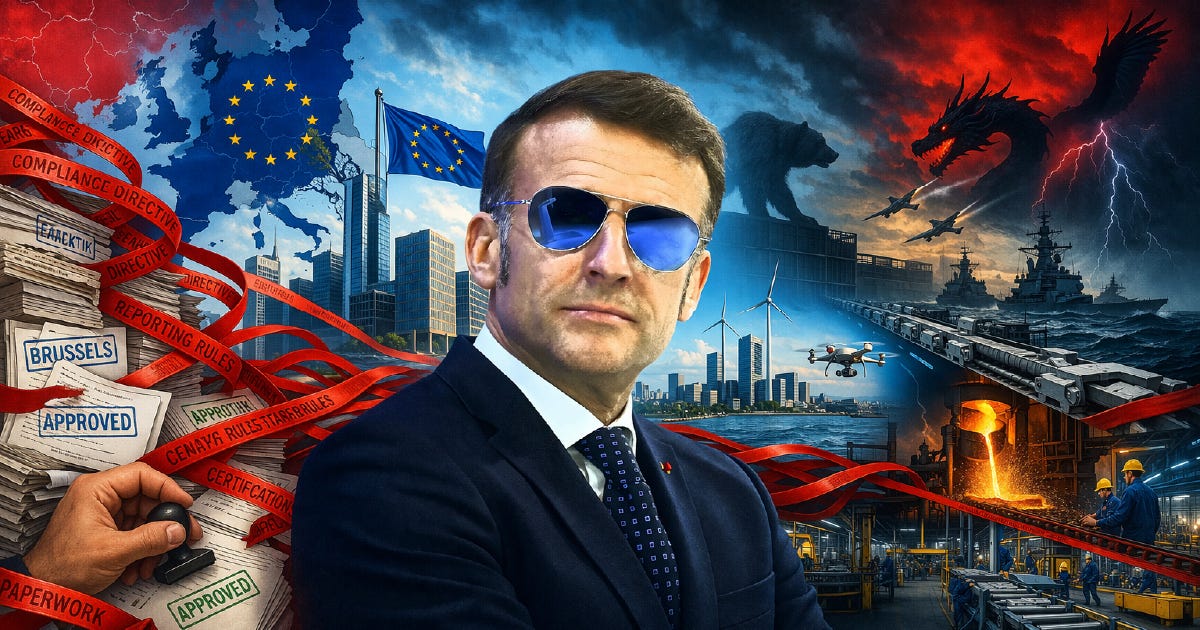
We have noted before how European states tend to have regulatory regimes that can range from thorough to onerous. This goes back quite a ways – it’s deep-seated, to say the least. While Britain historically has been more laissez-faire than Europe, the roots of heavy, directed regulation on the continent stretch back further, whether to Napoleon seeking to direct how France and its empire would function (he wanted to be remembered as a lawgiver more than as a conqueror) or to the cameral state of Prussia. Perhaps we could even reach back to medieval scholasticism and the story of theologians inquiring as to how many angels could dance on the head of a pin, but one way or another, Europe’s dirigisme is deep-seated. This will have to change, not just for defence purposes, but for economic dynamism writ large. Europe is a massive economic bloc that simply does not live up to its tremendous potential.
An End to the Peace Dividend
The end of the Cold War provided a peace dividend and allowed for not only different projects on which to spend, but space for other emphases, and at times, unwise and unwieldy regulation. On top of that, Europe, like its North American cousins, broadly deindustrialised. While neither an entirely bad thing nor entirely avoidable, it created some serious shortcomings that left Europe’s nations vulnerable. Britain, the birthplace of the Industrial Revolution, is now at risk of becoming the only G7 member unable to make its own virgin steel.1
Defence is a unique “foot in the door”, since its demand comes not only from consumer sentiment or economic forces, but from increasingly evident strategic uncertainty – whether from the threat of the Russian bear, the rising influence of the Chinese dragon, or the unpredictable flapping of the American eagle. In the event of a crisis that demands strategic autonomy, firmly worded statements, policy tinkering, and the balm of time simply will not suffice.
Industrialisation in India vs China
The stultifying regulatory regimes are a fine place to begin. European states’ attempts to build their own defence industries, when compared with other defence-industrial powerhouses (e.g, the U.S., China, and Russia), echo the difference between the processes of industrialisation in China and India.
India, when it became independent in 1947, inherited a well-developed civil service as a legacy of British rule. That, and Jawaharlal Nehru’s vision of a planned economy, produced something of a regulatory thicket that long held India back from the level or pace of industrial and economic development it might otherwise have achieved. Even since its liberalisation in the 1990s, it lags behind its potential.
China, on the other hand, industrialised at an incredible rate starting in the late 1970s, when Deng Xiaoping gave his official stamp of approval to grassroots economic changes that had already begun across the country and initiated the “reform and opening-up” (改革开放) policy, which kicked off the boom that birthed the Chinese superpower of today. Regulation came as well (and China’s doubtlessly leaves much to be desired), but it came along with and following industrialisation, similar to the pattern of western nations, freeing entrepreneurs from the effort of trying to fit square innovative pegs into round regulatory holes.
Is the EU India?
European defence industries stand in a situation not so dissimilar from India’s, speaking broadly. The regulatory regimes and the culture that underlies them are well-established, but the demands for more rapid innovation and development are pressing. The opportunities for real growth are there, only that they are choked by legacy constraints, even if they were established with the best of intentions.
There exist three broad “lines of effort” in defence – reinvigorating legacy industries to continue making and improving legacy tools and platforms, developing new technologies, and coordinating between the various cooperating states in the EU and in NATO. Like 20th century India, mazes of regulations and requirements make pursuing these efforts more complicated than it ought to be – and frankly, it is not going as efficiently as it needs to be.
A Good Place, For Sure
However, what Europe does have is a vast pool of talent in all of the relevant fields, massive amounts of potential capital, and a well-established habit and reputation for “playing by the rules,” whether internally as regards to the rule of law or externally in its dealings with foreign powers.
At the World Economic Forum this year, French President Emmanuel Macron – having donned some sharp-looking aviator shades – gave an address advocating for increasing investment in Europe’s own innovation, and for making it easier to do so. He pointed out, rightly, that Europe, whether as individual states or collectively, does not invest in itself - and that it’s just too damned difficult to do so. His multiple droppings of “for sure” sometimes seemed to pooh-pooh the issue, but with it he emphasised the fact that even with these issues, Europe is dependable, follows rules, and adheres to its own standards:
“…a place like Europe, which sometimes is too slow, for sure, and needs to be reformed, for sure, but which is predictable, loyal and when, well, you know that the rule of the game is just a rule of law, it’s a good place.”
The time of the peace dividend is over, and with it must end the labyrinthine regulatory regimes, the lack of seriousness about the dangerous world, and over-reliance on others. But with the correct policy catalysts, Europe could very well become a powerful force once again. In a tumultuous world, a Europe that is on a trajectory to reinvigorate its economic dynamism and take defence seriously while maintaining its hallmark predictability and reliability can only mean one thing: build.
Thank you for reading. We always welcome fresh perspectives and new contributions. If you are interested in writing for the Fox and Lion or have a piece that you would like to publish with us, please feel free to email us. We warmly welcome active and former servicemembers, and members of the defence tech community. Additionally, if you are hiring, email us to get your job featured in our next Defence Tech Jobs newsletter.
“Calls for steel nationalisation if deal not agreed” BBC, accessed: 23 March 2026, https://www.bbc.co.uk/news/articles/crrdrqx8pygo