
War Never Changes
And new technology has to take that into account to succeed

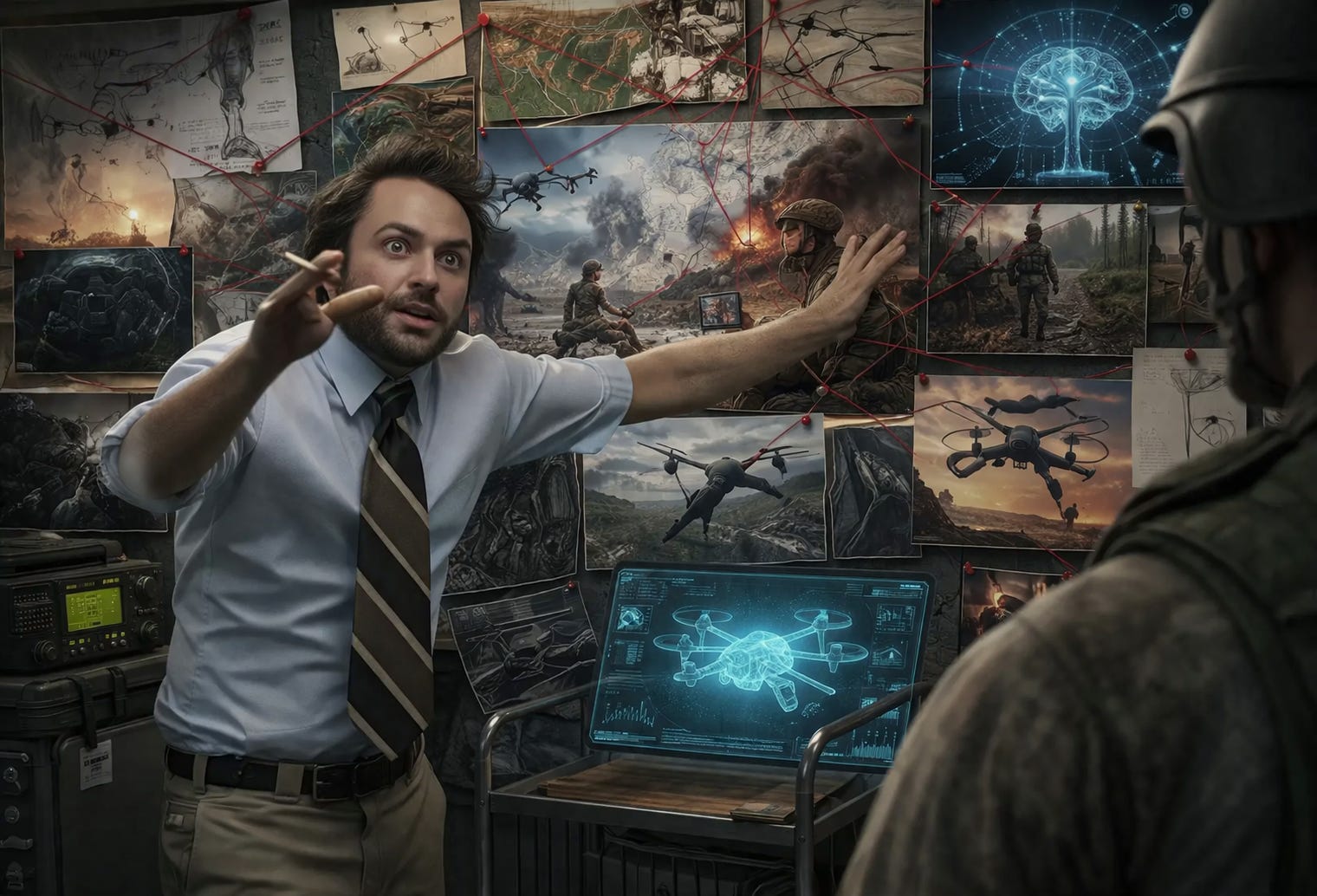
There has been much talk about how new tech is changing the battlefield - and not all of it recent. Take Winston Churchill’s 1932 essay, provocatively titled “Shall We All Commit Suicide?“, in which he reflected on the First World War, and the development of technology and industry. He wondered if future wars might be fought with “electrical rays [that] could paralyse the engines of a motor-car [or] claw down aeroplanes from the sky,” or if “explosives [could] be guided automatically in flying machines by wireless or other rays, without a human pilot, in ceaseless procession upon hostile city, arsenal, camp, or dockyard.”
Perhaps Churchill’s famously bald head served as a crystal ball of sorts, as his predictions turned out to be eerily accurate. However, while Churchill’s musings from the 1930s still echo today, the very nature of war remains unchanged. War is still very much a human endeavour - with all its inherent error and chaos.
From Swords to Guns to Swords
For example, yes, command posts are now remote, as Churchill also predicted – yet their electromagnetic signals now make them a new target for enemy fires and effects. We see warfighters in Ukraine resorting to guiding their drones with fibre optic cables –echoing the fighters of the “Dune” universe, who have gone so high-tech that they have circled back to low-tech melee.
And if there is new technology to be had, soldiers and officers still require extensive training in order to become effective warriors with this new technology, something we instinctively know and see reflected in our cultural imagination, with the likes of Luke Skywalker and Captain Kirk.
American historian (and WWII and Korean War veteran) T.R. Fehrenbach’s commentary on the Korean War, during which the newly constituted U.S. Air Force was expected to deliver swift victory from the air, still rings true: “You may fly over a land forever; you may bomb it, atomize it, pulverize it and wipe it clean of life - but if you desire to defend it, … you must do this on the ground… by putting your young men into the mud.”
The tools and technology may change, but they only serve to be better solutions to the same problems humans have encountered in warfare for the last 10,000 years.
What does this mean for a developer today?
If you’re making hardware:
Is it durable? If it’s a UAS, it’s not just the dramatic meaning of “durable,” when it’s actually flying over the enemy collecting information or dropping munitions, but the more mundane side, too. Will it survive transport in the back of a truck? A vehicle rollover when all the transportation cases get thrown around? How about a tired, frustrated, maybe a bit clumsy 19-year-old soldier trying to get it to work?
Is it attritable? Depending on what you make, it might be something that is cheap to build and use, but while being attritable, it’s got to be robust enough to still do its job.
Is it portable? If it’s something that will be used by infantrymen – who will always be on the battlefield, no matter what amazing whizzbangs and whirlygigs we invent – can they carry it? How many can they carry? Can they fix it? Can they charge it?
If you’re making software:
Is it enabling decision-making? or just bombarding leaders with information overload? Is it simple to figure out? From experience, there are few more frustrating things for a line unit - that already has a full plate with training, maintenance, and inspections - to be forced to use some newfangled software that is “really powerful” but requires a 40+ hour course to learn, and without which it remains utterly mystifying. The proliferation of military mobile devices in European armies has already begun. Is what you are building something that a platoon sergeant in a patrol base can effectively use –while his men are in a direct firefight around him?
If you’re developing AI:
For all the ballyhoo about AI’s rapid growth in capabilities, if there is little appetite from business leaders to hand actual decision making to AI, there is even less from military commanders, let alone their bosses in government.
How do humans insert themselves or relate to whatever AI is being tasked with doing? Is the information the AI is drawing from, or trained on, up-to-date? Or say, to use a hypothetical NATO versus Russia fight as an example – since that is Europe’s pacing threat – could it distinguish between a Bulgarian friend and a Russian foe, both of whom might be driving around in old Soviet BMPs?
Same Same, but Different
Considerations such as these are as old as warfare itself, and they still apply today, no matter how new the tools and technologies are. A rainy night or two in the woods offers a sharp reminder of how mud, weather, temperature, terrain, and our own human limitations remain constant planning factors in war. We get more than enough sensory overload from the computers in our pockets – we know what it’s like to have to sift through windows and tabs and apps and passwords. Now imagine that, with far more information, and with lives on the line.
Running through questions like these is an absolute imperative for any developer aspiring to create a product for military use. This sector is a wide-open horizon for innovation. The products and tools that survive and thrive will be those that are built with a mind towards the enduring realities of war. Imagination is one of the most powerful tools for any inventor, or for any leader – and that imagination must encompass not just the modern magic of technologies themselves, but all the randomness, mud, rain, chaos, brutality, and humanity that existed outside the walls of Troy and today in the trenches of the Donbas and in the battles of tomorrow.
Thank you for reading. We always welcome fresh perspectives and new contributions. If you are interested in writing for the Fox and Lion or have a piece that you would like to publish with us, please feel free to email us. We warmly welcome active and former servicemembers, and members of the defence tech community. Additionally, if you are hiring, email us to get your job featured in our next Defence Tech Jobs newsletter.