
Move Fast and Break Things
Can European governments accept failure as the price of innovation?

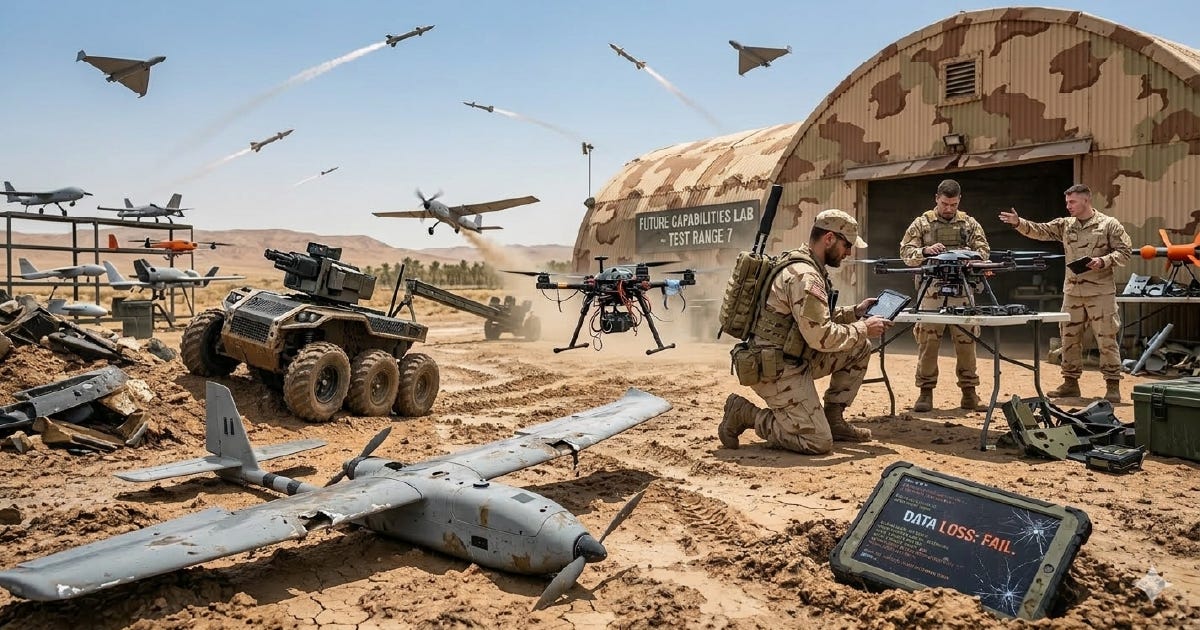
Modern technology is changing the battlefield in unprecedented ways. While the very fundamentals of war, things that were true for Napoleon and Sun Tzu, have remained the same, the tools of war available today demand a degree of experimentation and pace of learning not seen since the advent of machine guns, mechanised vehicles, and aircraft.
Military forces and defence ministries are large, bureaucratic organizations, and their acquisition processes have long been based around the development and fielding of platforms that took years to design, build, and deliver. Once delivered, integrating them has generally been a straightforward affair, since they were developed with certain tactical and operational approaches in mind, as well as logistical requirements. The assumptions that enabled this practice have now evolved.
Steel, Not Flesh
During the Second World War, the British Army deliberately took an approach that has been described at times as “steel, not flesh.” After the gruesome experience of the First World War, its leadership decided to invest heavily in mechanisation and other technological advances to increase survivability and preserve manpower while also increasing their forces’ lethality on the battlefield.
As doctrine and operational concepts evolved following the Second World War, the British Army could continue to upgrade and develop tanks and other mechanised platforms along similar principles. Although doctrine evolved, neither it nor the tools available (in this case, tanks) changed in any radical way. Basic assumptions about firepower, survivability, and how to deploy mobility did not change.
Same, But Different
Today’s technology is simply developing far faster than any point in human history, even if certain imperatives and demands remain. Drones, for instance, echo the spirit of “steel, not flesh,” but invert the technological logic. For the British Army in WWII, platforms like the Matilda or Churchill tanks were designed to allow front line troops to push ahead while withstanding withering fire from the enemy. Today, unmanned systems often go far ahead of the forward line of troops, often into areas where troopers on the ground might not otherwise go or even be able to go.
Of course, there are risks involved. But whereas previous mechanised platforms were designed to increase survivability by physically protecting soldiers themselves, unmanned systems can be targeted and destroyed in place of live soldiers, all while amplifying what soldiers themselves can do on the battlefield. Drones, at the end of the day, are expendable and attritable by design. The guiding maxim of “steel, not flesh” remains (although today it would also include plastic, carbon fibre, and endless spools of fibre optic cables) and is followed in a different way with a different set of tools.
Things Break
However, military forces are still wrapping their heads around how to employ them, how to sustain them, what kinds to use. And during this process drones break, whether from enemy fire, weather, or operator error. This does not fit neatly within legacy frameworks for developing, purchasing, or integrating systems. This is all but antithetical to the legacy acquisitions model.
Integrating such new systems and tools will, by nature, be a discovery process. There needs to be more room for experimentation, and as often, if not always, happens with lab experiments, things will break, systems will fail, and new questions, challenges, and opportunities will arise. Creating this space, especially to allow for learning and development at the pace that the current threat environment demands, will itself be a process—one that has been seen as wasteful and unfocused by militaries and governments for the better part of the last century. It is now a process that they must adapt or die.
Militaries and governments will have to adjust to the new reality that requires a significantly higher pace of innovation and creativity, as some already have (notably, the United States is forging ahead in this regard). This means willingness to invest in new projects – some of which may fail. It means being willing to experiment with a variety of concepts – some of which may fail. It means being open to professional input from both within the ranks and beyond them, from policy experts and technologists alike. It also means being willing to test things, even to the point of breaking them, along with old assumptions… in short, fly the damn drones, hard and fast, and see what happens.
Ultimately, the ball is in their court, so to speak, and any senior leader or policymaker who has been watching current conflicts is surely aware of this burning necessity. Developers have a role, too, though. It is a tremendous opportunity. Those who can build simple, inexpensive, and attritable systems will fill a crucial requirement. Modern (and modernising) European forces are relatively small and highly professional, which puts a huge premium on manpower. Thus, any tool that can amplify capabilities and, at times, take the place of live soldiers will be in high demand. Militaries and defence ministries are looking for these types of systems; developers should be building them.
As our friends in Silicon Valley love to say, “Move fast and break things.”
Thank you for reading. We always welcome fresh perspectives and new contributions. If you are interested in writing for the Fox and Lion or have a piece that you would like to publish with us, please feel free to email us. Additionally, if you are hiring, email us to get your job featured in our next Defence Tech Jobs newsletter.